Architecture and deployment profiles
The cloud gateway is the product entry point. Self-hosted deployment profiles are available when you want to run the platform yourself. The repository has a local profile, a customer-cluster profile, and tenant onboarding examples. They share the first-party services and Helm charts. Each profile installs its own Argo CD application set and carries its own security and availability posture.
Use the feature inventory for endpoint and default status, and the threat model for trust boundaries.
Core request path
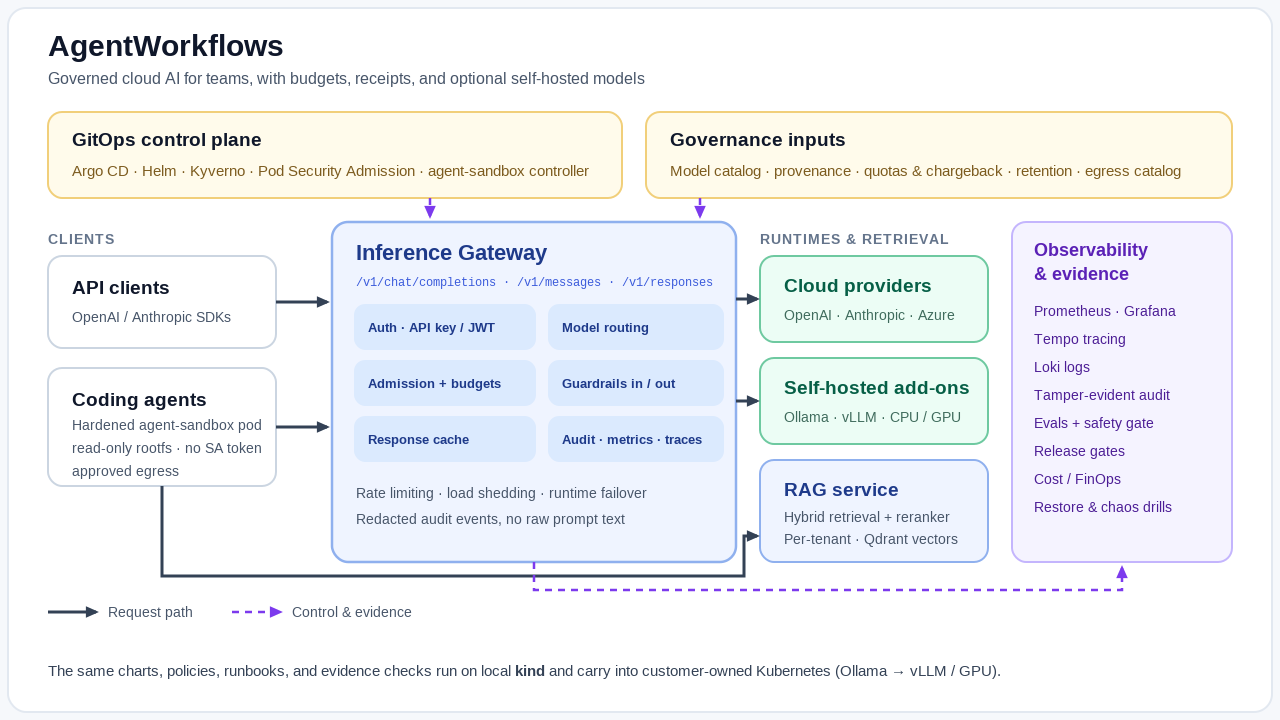
The inference gateway is the entry point for model API traffic. A normal request passes through:
- API-key or bearer-token authentication;
- sandbox identity binding, when the key record or token supplies one;
- model allowlist, admission, and input-secret checks;
- rate and budget accounting;
- classification-constrained routing to an approved cloud provider or optional Ollama/vLLM backend;
- the optional output guardrail;
- metrics and a redacted audit event.
The exact HTTP surface is generated into platform/api-contracts/inference-gateway.openapi.json. Optional controls apply when they are enabled in the active values.
RAG is a separate service. It returns retrieved passages and grounded message objects, and clients call it directly alongside the gateway. The local profile uses the checked-in lexical corpus. The customer values select Qdrant and an embedding endpoint.
The bundled React console calls same-origin /v1 APIs. API credentials are exchanged
for opaque Redis-backed sessions; browser writes require a CSRF header and cookie.
OIDC uses authorization code, PKCE, state and nonce checks. Team/project roles are
checked by the gateway, including reads of runs, SSO policy, spend and exports.
Run start, cancellation and review operations coordinate with Temporal. Workers poll Temporal task queues and send governed activities back through the gateway, so the gateway remains the authorization point. Redis retains live accounting, sessions, coordination and captured content. Gateway history, receipts, audit, managed-key metadata and settings use Redis (default) or PostgreSQL. Temporal has its own PostgreSQL databases, separate from optional gateway storage. Worker and Temporal access are trusted operator surfaces; keep them on the operator side of the tenant boundary.
Framework agents execute inside Temporal activities and point their clients at this gateway.
Workflow policies and MCP registrations extend the existing SandboxPolicySet; run accounting
and expiring container credentials use its existing Redis backend. MCP calls share input/output
DLP, budgets, and receipts with HTTP tools. Container steps execute approved commands in existing
agent-sandbox workspaces through narrowly scoped worker RBAC. See workflows.
Components
The namespaces below describe the separate GitOps charts. The umbrella chart installs its enabled components together in the release namespace; Compose uses container networking.
| Component | Namespace | Source | Notes |
|---|---|---|---|
| Inference gateway | inference |
src/inference-gateway, deploy/charts/inference-gateway |
First-party API and policy point |
| Temporal, PostgreSQL, workflow worker | workflows |
sdk/python, deploy/charts/workflows |
Official Temporal chart; governed activities, durable history, and approval signals |
| RAG service | rag |
src/rag-service, deploy/charts/rag-service |
Lexical or Qdrant retrieval |
| Budget Redis | budget |
deploy/charts/budget-redis |
Single-node reference store by default |
| Qdrant | vector |
deploy/charts/qdrant-vector-store |
Single-instance chart; customer values enable persistence |
| Ollama | ollama |
deploy/charts/ollama |
Local default and a customer chat route |
| vLLM | vllm |
deploy/charts/vllm |
Customer generation and embedding profiles |
| Agent workspace | tenant namespace | deploy/charts/agent-workspace |
Creates agents.x-k8s.io sandbox resources and namespace controls |
| Agent-sandbox controller | agent-sandbox-system |
deploy/vendor/agent-sandbox |
Cluster-scoped prerequisite |
| Policies and catalog | cluster/inference | deploy/policies, platform/model-catalog |
Admission policy and approved model records |
The data plane uses plaintext HTTP by default, and NetworkPolicy restricts reachability. Add transport encryption at the cluster or mesh layer where your environment requires it.
Local profile
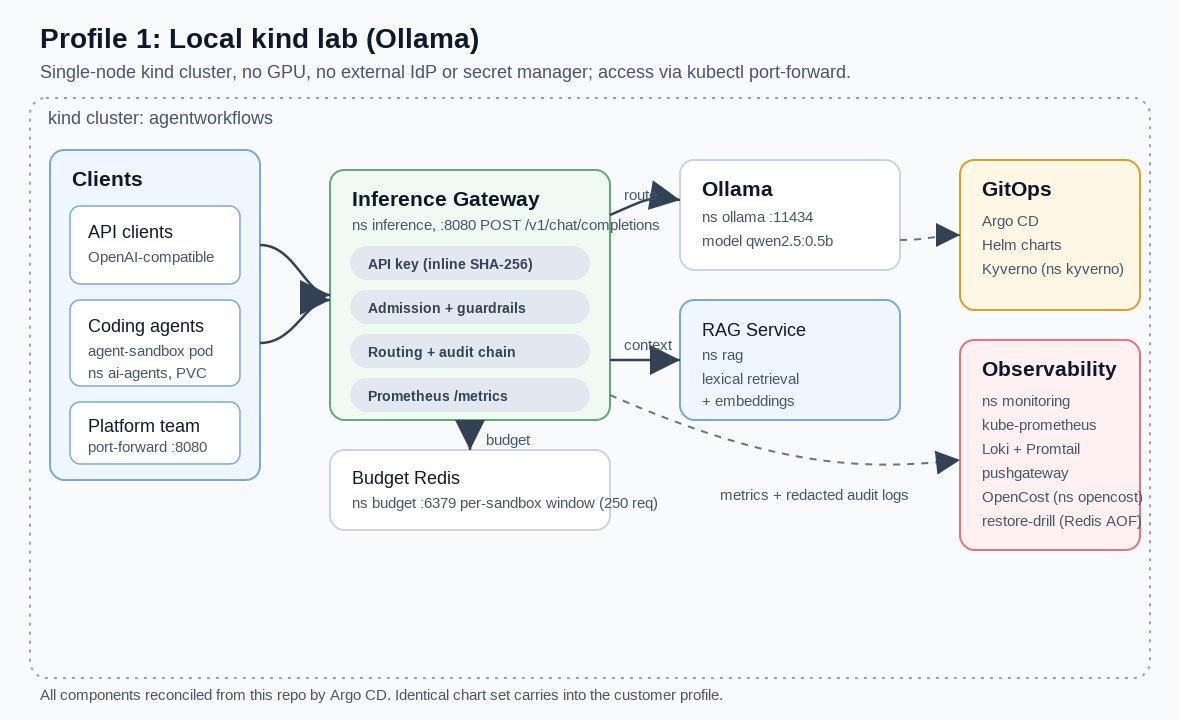
make quickstart creates a single-node kind cluster with Calico, builds the gateway and RAG images locally, installs the vendored agent-sandbox controller, and deploys the local application set.
The local profile uses:
- Ollama with
qwen2.5:0.5bfor gateway smoke tests; - a public development API key;
- lexical RAG data from the repository;
- a bundled Redis and Qdrant footprint;
- local-path storage and single-node availability.
The default Argo CD path includes platform operators, observability, policies, cost controls, and backup examples. QUICKSTART_DIRECT_APPLY=1 is intentionally smaller: it applies the core runtime charts directly and leaves out those add-ons.
The local path downloads images and models over the network during setup. Once those components are installed, inference requests stay on the local cluster. For an offline installation, follow the restricted-egress guidance in the regulated-offline tenant example.
Customer profile
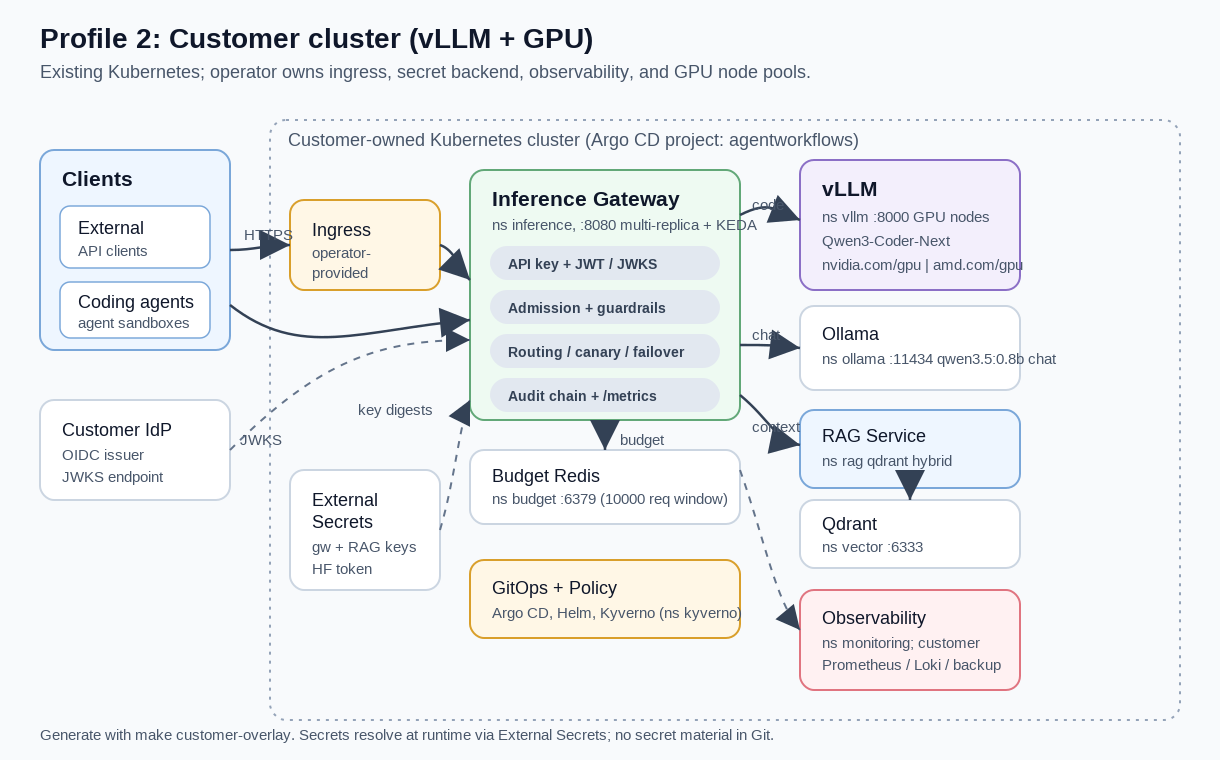
The customer profile runs on a cluster that already has Argo CD, ingress, secret integration, observability, and backup systems. Its Argo CD application list is deliberately smaller than the local list: it installs the platform services and relies on the cluster's own observability, cost-control, platform-operator, and backup tooling.
The checked-in customer values deploy both Ollama and vLLM routes. They also add a separate vLLM embedding service and configure RAG to use Qdrant. The NVIDIA example requests four GPUs per vLLM replica and keeps at least two replicas when KEDA is enabled. Those values describe a large reference configuration; size your own deployment from your workload.
Before deployment, the operator:
- configures a reachable, immutable Git revision;
- installs and configures the required operators, including External Secrets if those manifests are used;
- replaces identity and secret placeholders;
- selects storage classes and backup targets;
- chooses model artifacts and verifies their provenance;
- sizes GPU count, context length, replicas, and persistent volumes;
- connects metrics, logs, alerts, ingress, and transport encryption.
See the customer deployment guide.
regulated-offline tenant example
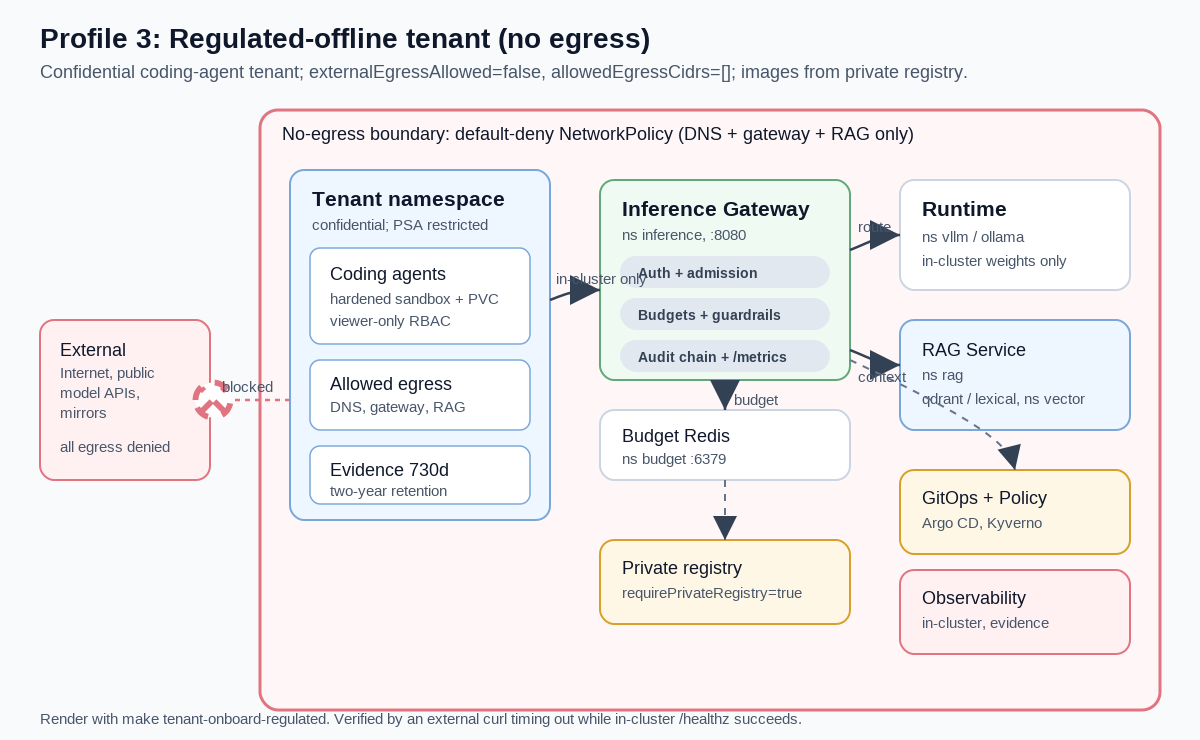
tenants/onboarding/regulated-offline-coding-agents.yaml is a tenant policy example. It renders a namespace with external CIDR egress closed and allows only DNS plus the in-cluster gateway and RAG service.
The tenant policy governs the tenant namespace. A fully offline deployment adds private registries and mirrors, preloaded model weights, internal Git and identity endpoints, and cluster-wide egress controls for image pulls, model downloads, Argo CD, the gateway namespace, the identity provider, and other cluster services.
Use the restricted-egress tenant walkthrough to render and inspect the manifests.
Stateful and failure boundaries
The bundled Redis, PostgreSQL, Qdrant, and Loki configurations are development/reference footprints. Redis uses AOF and a PVC for run budgets; Temporal has dedicated PostgreSQL storage. Both are single instances. Qdrant is a single instance, and the local observability stack is a single-node logging setup. For production availability, move these to managed stores using the external stores runbook.
Workflow state lives in Temporal. The SDK schedules model/tool activities on the existing governed gateway path; Redis holds accounting only. See workflows for replay, in-flight calls, idempotent tools, and approval trust boundaries.
The gateway audit chain is per process/replica. To use the log as tamper or rollback evidence, export records and store chain-head anchors outside the gateway.
Team operations
Teams extend sandbox identity with projects and verified roles. The gateway API controls Temporal executions on each team's task queue; workers retain team-bound execution keys. Run metadata/timeline indices and atomic cross-provider spend reservations share the existing budget Redis. Provider secrets stay on the gateway and are selected by verified team identity. Temporal history remains the execution authority, and the receipt index works alongside retained audit chains and external anchors. See team operations.